

You set the thermostat. Nothing happens. No fan, no compressor, no sound at all. Or the thermostat screen is blank.
A completely dead AC is alarming, but the cause is often something you can check yourself before calling anyone.
Start here
Thermostat. Look at the display. If it is blank, the batteries may be dead. Replace them. If the display is on, confirm it is set to "cool" and the set temperature is below the room temperature. Some thermostats have a delay built in after a mode change. Wait five minutes before concluding nothing is happening.
Breaker. Go to your electrical panel and find the breaker labeled for the air conditioner or air handler. If it has tripped to the middle position, switch it fully off, then back on. If the breaker trips again immediately or within a few minutes, stop. A breaker that will not stay on is protecting you from an electrical fault. Do not force it. Call a technician.
Disconnect box. There is a gray box mounted on the wall near your outdoor unit. Inside is a pull-out disconnect — a small block that you remove to cut power and reinsert to restore it. Confirm it is fully seated. These can vibrate loose over time, or someone may have pulled it during previous service and not reinserted it completely.
Float switch. Most Florida systems have a safety float switch on the condensate drain. If the drain line is clogged and the drain pan fills with water, the float switch shuts down the entire system to prevent water damage. Look at the indoor air handler. If there is standing water in the drain pan or water on the floor beneath it, the drain line is clogged. You can try clearing it (see our drain line post), but the float switch did its job — the system will not restart until the water level drops.
Causes that need a technician
Bad capacitor. The capacitor stores the electrical charge that starts the compressor and the fan motor. When a capacitor fails, you may hear a clicking or humming sound from the outdoor unit, but neither the compressor nor the fan will start. Capacitors fail more often in extreme heat. This is a common and relatively inexpensive repair, but it requires handling high-voltage components.
Contactor failure. The contactor is a relay that sends power from the disconnect to the compressor and fan motor. Over time the contact points wear or pit, and the contactor stops closing the circuit. The thermostat sends the signal, but nothing downstream responds.
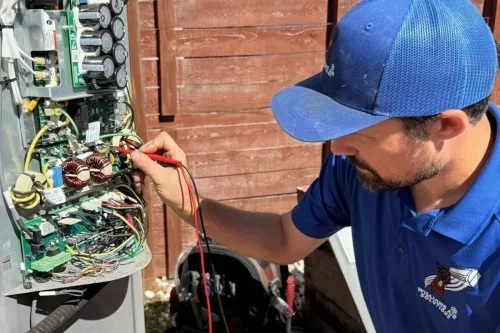
Control board. The control board in the air handler sequences the startup — it tells the blower, compressor, and safety circuits when to engage. A failed board can prevent the system from starting at all or cause it to start and immediately shut down. This is less common than a capacitor or contactor but does happen, especially on systems older than 12 to 15 years.
The pattern to notice
If the system was working yesterday and is completely dead today, the most likely causes are a tripped breaker, a tripped float switch, or a failed capacitor. If it has been getting progressively weaker and finally stopped, the problem may be deeper — a compressor winding, a refrigerant leak that froze the coil, or an aging control board.
Call (727) 477-3256. We work 24 hours, 7 days. Describe what happened and we will bring what is likely needed.