

The thermostat reads 74. The living room is comfortable. The back bedroom is 80 and the AC vent in there is barely blowing.
This is rarely an AC problem. The system is producing cold air. The question is whether that air is reaching every room.
The most likely cause: ductwork
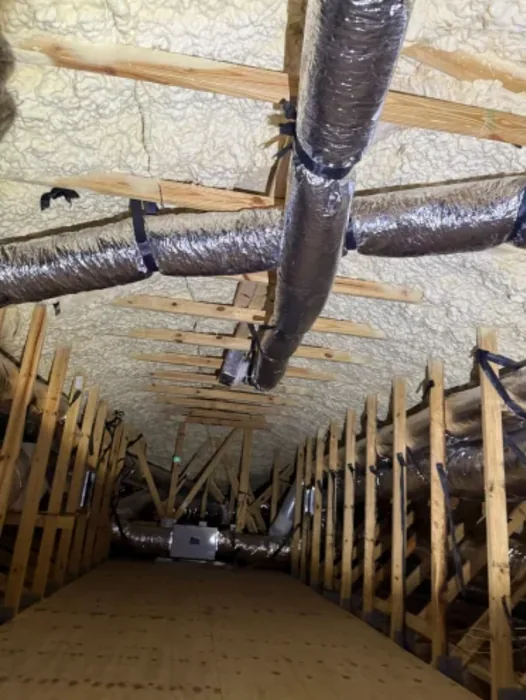
In most Florida homes, the ductwork runs through the attic. Attic temperatures in Pinellas County reach 140 to 150 degrees in summer. Any gap, disconnection, or poorly insulated section of duct in that space loses cooled air into the attic and heats whatever does make it through.
Disconnected duct run. A flex duct that has pulled loose from its collar or trunk line delivers almost no air to the room it serves. This happens from age, poor installation, or someone stepping on a duct during other attic work. The room gets hot. The rest of the house seems fine because the system's total output is barely affected — one run is a small fraction of the whole.
Leaking duct joints. Every connection point is a potential leak. Flex duct slipped back from its collar, rigid duct seams that were never sealed, branch takeoffs that were taped with cloth duct tape (which degrades in attic heat within a few years). Cooled air leaks into the attic before reaching the room.
Undersized duct run. If the duct serving a large room is too small in diameter or has too many bends, it cannot deliver enough airflow even when the system is working perfectly. This is a design problem from the original installation.
Poor insulation on the duct. Flex duct has built-in insulation, but if it has compressed, torn, or been pulled apart, the cooled air inside heats up on its way to the room. A 30-foot run through a 150-degree attic with damaged insulation can lose 10 to 15 degrees before reaching the vent.
Other causes
Closed or blocked vents. Walk the warm room. Is the supply vent open? Is furniture sitting on top of a floor register or pushed against a wall vent? A blocked vent does the same thing as a closed damper — the room gets no air.
Sun exposure. A room with large west-facing windows absorbs solar heat all afternoon. The AC may be delivering the same air to every room, but this room has a higher heat load. Window film, blinds, or a dedicated mini split for that room are the practical solutions — the AC is not undersized, the room just needs more than its share.
Return air imbalance. If a room has a supply vent but no return air path (no return grille, and the door is kept closed), the room pressurizes. The supply vent pushes air in, but air cannot circulate back to the system. Cooling drops. Opening the door or adding a return path fixes this.
What actually fixes it
For duct problems, the fix is in the attic, not at the thermostat. A technician needs to inspect the duct run serving the warm room — check for disconnections, reseal joints with mastic, verify insulation integrity, and measure airflow at the register. If the duct is undersized, it may need to be replaced with a larger diameter run.
Call (727) 477-3256. Tell us which room and we will check the duct run that serves it.