

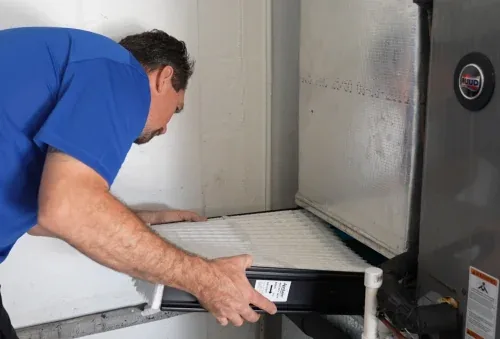
Every pleated air filter has an arrow printed on the frame. It indicates the direction of airflow. Installing it backward restricts airflow and reduces filter life.
The rule
The arrow points in the direction the air is moving — toward the blower, away from the return.
If the filter is at the return grille on the wall: The arrow points toward the wall (into the duct, toward the air handler).
If the filter is at the return grille on the ceiling: The arrow points up toward the ceiling (into the duct above).
If the filter is inside the air handler: The arrow points toward the blower and the evaporator coil — which is the direction the air moves through the system.
Why it matters
The filter is designed so the reinforced side faces the pressurized downstream side (toward the blower). Installed backward, the pressure pushes against the weaker upstream side of the media, which can collapse the pleats, reducing surface area and increasing resistance. A backward filter works, but it works worse and wears out faster.
If you cannot find the arrow
Some flat fiberglass filters do not have arrows because they are not directional — either side faces either direction. Pleated filters always have an arrow. If you cannot see it, look along all four edges of the cardboard frame.