

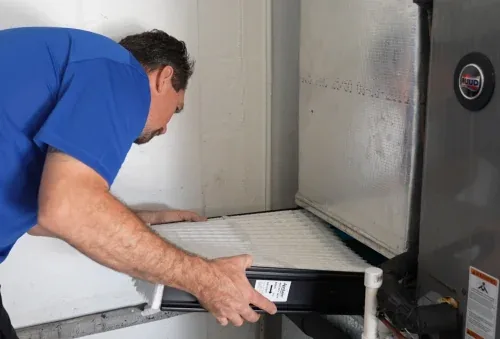
You pull out the old filter to replace it and realize you do not have a replacement. The house is 85 degrees. The temptation is to run the system without the filter until you can get to the store.
A few hours will not destroy the system. But it is not harmless, and making it a habit will create expensive problems.
What the filter actually protects
The filter is not primarily there for your lungs. It is there for the evaporator coil.
The evaporator coil has thousands of thin aluminum fins packed tightly together. Air passes between those fins, and refrigerant inside absorbs the heat. When there is no filter, every particle in the return air — dust, pet hair, pollen, skin cells, lint — passes directly over those fins and sticks to the condensation on the coil surface.
Over weeks or months of running without a filter, the coil develops a layer of grime that:
- Reduces heat transfer. The grime insulates the coil, reducing its ability to absorb heat. Cooling output drops. The system runs longer.
- Restricts airflow. The debris between the fins creates the same resistance a dirty filter would, except now it is bonded to the coil and cannot be changed in 30 seconds. Professional cleaning is required.
- Clogs the drain line faster. The grime washes off the coil with the condensation and flows into the drain pan and drain line. The line clogs more frequently.
The air quality side
Without a filter, every particle the system pulls through the return grille circulates through the house. Dust, mold spores, and allergens that the filter would have caught blow directly out of every supply vent. Anyone with allergies, asthma, or respiratory sensitivity will notice.
What to do if you do not have a replacement
Run to the store. It is worth the trip. If you cannot get a filter for a day, running the system without one for 24 hours is unlikely to cause visible damage to the coil. Beyond that, the accumulation starts. If you go weeks, you are trading a $5 filter for a $200 to $400 coil cleaning.
Never cut a filter to fit or fold one to make it work. A filter that does not fill the slot has gaps around the edges, and the system will pull air through those gaps instead of through the filter media. It is barely better than no filter at all.