

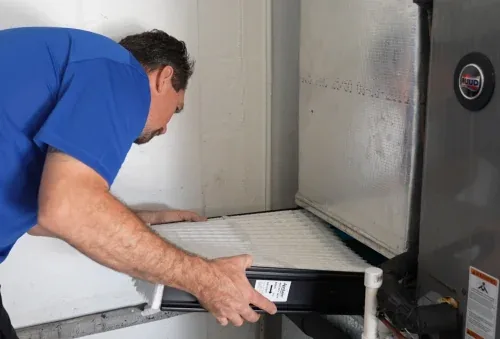
MERV stands for Minimum Efficiency Reporting Value. It measures how effectively a filter captures particles of different sizes. The scale runs from 1 to 20. Higher numbers catch smaller particles.
The instinct is to buy the highest MERV rating available. Better filtration sounds like a good thing. But filters and air conditioners are a system, and the filter's job is not just to catch particles — it is to catch particles while allowing enough air through for the AC to function.
What happens with too high a MERV rating
A higher MERV filter has a tighter weave. A tighter weave means more resistance to airflow. That resistance is measured as pressure drop, reported in inches of water column (in. WC).
Most residential AC systems are designed to operate below 0.50 in. WC of total external static pressure. A clean 1-inch pleated filter at MERV 8 creates roughly 0.10 to 0.15 in. WC of pressure drop. A 1-inch MERV 13 filter creates 0.30 to 0.40 in. WC when clean — and higher as it loads with dust.
That leaves almost no room for the rest of the system's pressure losses (duct friction, coil, registers). The blower motor — especially a PSC motor, which is what most residential systems in Florida have — cannot compensate. It spins at the same speed regardless of resistance. As the filter loads, airflow drops.
The consequences:
- Coil freezing. Less air across the evaporator coil means the coil temperature drops below freezing. Ice forms. The system stops cooling.
- Higher energy use. The system runs longer because less air is being conditioned per cycle.
- Blower motor strain. The motor works against higher resistance for more hours per day. It runs hotter. It fails sooner.
- Premature filter loading. The tighter weave clogs faster, compounding the airflow problem within weeks.
What to actually buy
MERV 8 to 11 suits most standard residential systems with a 1-inch filter slot. This range captures dust, pollen, mold spores, and pet dander — the particles that matter for comfort and basic air quality.
MERV 13 is appropriate only if your system can handle the pressure drop. Systems with variable-speed (ECM) blower motors tolerate higher-MERV filters because the motor adjusts speed to maintain airflow. If you have a standard single-speed or PSC motor, MERV 13 in a 1-inch slot is likely too restrictive.
If you genuinely need higher filtration — for medical reasons, severe allergies, or air quality concerns — the answer is not a higher-MERV 1-inch filter. It is a 4-inch or 5-inch deep media filter. The additional depth provides far more surface area, which means better filtration at a lower pressure drop. A 4-inch MERV 13 filter has roughly the same pressure drop as a 1-inch MERV 8.
The takeaway
The number on the filter is not a quality score. It is a filtration grade that must match your system's airflow capacity. A MERV 8 filter on a system designed for MERV 8 performs better than a MERV 13 that chokes the same system.
If you want to upgrade filtration, ask a technician to measure your system's static pressure first. That measurement tells you exactly how much filter the system can handle.
Call (727) 477-3256 if you want to know which MERV rating is right for your system.